Top Ten Discoveries of 2010: Nat Geo News's Most Popular
No. 10 Chile Earthquake Altered Earth Axis, Shor
Ten ed Day
Saturday's Chileearthquake was so powerful that it likely shifted an Earthaxis and shor
Ten ed the length of a day, NASA announced Monday.
By speeding up Earth's rotation, the magnitude 8.8 earthquake—the fifth strongest ever recorded, according to the USGS—should have shor
Ten ed an Earth day by 1.26 millionths of a second, according to new computer-model calculations by geophysicist Richard Gross of NASA's Jet Propulsion Laboratoryin California.
For comparison, the same model estimated that the magnitude 9 Sumatra earthquake in December 2004 shor
Ten ed the length of a day by 6.8 millionths of a second.
Gross also estimates that the Chile earthquake shifted Earth's figure axis by about three inches (eight centimeters).
Deviating roughly 33 feet (10 meters) from the north-south axis around which Earth revolves, the figure axis is the imaginary line around which the world's unevenly distributed mass is balanced.
To explain the difference, Keith Sverdrup, a seismologist at the University of Wisconsin-Milwaukee, likened Earth to a spinning figure skater holding a rock in one hand. The rotational axis of the skater is still down the middle of the body, he said, but the skater's figure axis is shifted slightly in the direction of the hand holding the rock.
(Chile Tsunami Pictures: Earthquake's Other Aftermath.)
How Chile Earthquake Shor
Ten ed Day
Just how did the Chile earthquake give Earth a bit of a turbo boost?
To explain, Sverdrup, who wasn't involved in the NASA calculation, turned again to the image of a spinning figure skater. "As she pulls her arms in, she starts rotating faster."
Likewise, as a portion of Earth's mass drew in ever so slightly and quickly during the Chile earthquake, the planet began spinning a bit quicker.
The Chilean quake was a so-called thrust earthquake, which occurs when a large section of the Earth's surface—in this case, the Nasca tectonic plate—dives beneath an adjacent plate. This process, called subduction, can cause earthquakes and volcanic eruptions (learn about plate tectonics).
"The layer of rock on the [Nasca plate] dove down into the Earth's interior, and that's like the skater pulling her arms in toward her body," Sverdrup said.
Only thrust earthquakes, with their inward motion, can shor
Ten Earth days. Other types of earthquakes, such as horizontal strike-slip quakes, in which two plates slide horizontally past one another, don't affect Earth's rotation.
Currently, scientists can measure the length of an Earth day with an accuracy of only about 20 millionths of a second, so the shor
Ten ed day caused by the Chile earthquake can be estimated but not measured.
But "that doesn't mean that the effect isn't real," Sverdrup said—though it is ephemeral. The shor
Ten ing of Earth's day caused by the Chilean earthquake won't be permanent, although exact duration of the effect can't be measured.
Thrust earthquakes aren't the only phenomena that can shor
Ten , or lengthen, Earth days. Volcanic eruptions or tidal effects from the moon can also cause such effects.
2010 Chile Earthquake Born in 1960?
The recent Earth-axis jolt may have been the result of stress buildup from a magnitude 9.5 quake that struck Chile in 1960, scientists announced in a separate study yesterday.
"The story is quite similar to the December 26, 2004, magnitude 9.0 Sumatra earthquake, which was followed by a magnitude 8.7 quake on [the Sumatra fault's] southern end on the 28th of March 2005," geologist Jian Lin of Woods Hole Oceanographic Institution in Massachusetts said in a statement.
"The only difference is that it took 50 years for the northern neighboring section of the 1960 [Chile] earthquake to rupture, while it took only three months for the southern adjacent segment to rupture in Sumatra."
It's unclear why the Chile fault took so much longer than the Sumatra fault to "follow up," Lin added.
"But even 50 years is short enough [to fall within] a person's lifetime," he said. "Thus, we should consider the earthquake-interaction possibility seriously."
The Coma Galaxy Cluster, which appears to participate in the mysterious motion known as dark flow.
No.9 New Proof Unknown "Structures" Tug at Our Universe
"Dark flow" is no fluke, suggests a new study that strengthens the case for unknown, unseen "structures" lurking on the outskirts of creation.
In 2008 scientists reported the discovery of hundreds of galaxy clusters streaming in the same direction at more than 2.2 million miles (3.6 million kilometers) an hour.
This mysterious motion can't be explained by current models for distribution of mass in the universe. So the researchers made the controversial suggestion that the clusters are being tugged on by the gravity of matter outside the known universe.
Now the same team has found that the dark flow ex
Ten ds even deeper into the universe than previously reported: out to at least 2.5 billion light-years from Earth.
After using two additional years' worth of data and tracking twice the number of galaxy clusters, "we clearly see the flow, we clearly see it pointing in the same direction," said study leader Alexander Kashlinsky, an astrophysicist at NASA's Goddard Space Flight Center in Maryland.
"It looks like a very coherent flow."
The find adds to the case that chunks of matter got pushed outside the known universe shortly after the big bang—which in turn hints that our universe is part of something larger: a multiverse.
Dark Flow's Ex
Ten ded Reach
Kashlinsky and colleagues first noticed the dark flow when studying the way gas in galaxy clusters interacts with the cosmic microwave background radiation. This burst of light is thought to have been released just 380,000 years after the big bang and now permeates the universe.
Data from the Wilkinson Microwave Anisotropy Probe (WMAP) can show the minute temperature changes created as the cosmic microwave background radiation moves through gases in galaxy clusters.
These gases scatter light from the cosmic microwave background radiation as it passes through the clusters, similar to the way Earth's atmosphere can scatter starlight, making some stars twinkle.
But the clusters are also moving relative to the background radiation, so the scattered light gets distorted further by the Doppler effect. This distortion appears in the form of temperature shifts in WMAP data, which can reveal the clusters' direction and speed.
"It is very difficult to isolate [the temperature change] for each individual cluster," Kashlinsky said, so the original study had examined 700 clusters.
The new study is based on the collective motion of about 1,400 galaxy clusters, and seeing dark flow with the greater number of clusters gives the researchers more confidence in their result.
In addition, the team tested their analysis method by comparing the x-ray brightness of certain clusters with the strength of temperature changes seen in the WMAP data. Brighter clusters—those with more hot gases—would be expected to have greater effects on the cosmic microwave background, and that's what the new study confirmed.
Kashlinsky speculates that the dark flow ex
Ten ds "all the way across the visible universe," or about 47 billion light-years, which would fit with the notion that the clusters are being pulled by matter that lies beyond known horizons.
Dark flow, he said, "would be much more difficult to explain theoretically if it ex
Ten ded [2.5 billion light-years] and then just s
Top ped."
A yellow-bellied three-toed skink carrying embryos, visible as light orbs inside its body.
No 8. Evolution in Action: Lizard Moving From Eggs to Live Birth
Evolution has been caught in the act, according to scientists who are decoding how a species of Australian lizard is abandoning egg-laying in favor of live birth.
Along the warm coastal lowlands of New South Wales (map), the yellow-bellied three-toed skink lays eggs to reproduce. But individuals of the same species living in the state's higher, colder mountains are almost all giving birth to live young.
Only two other modern reptiles—another skink species and a European lizard—use both types of reproduction. (Related: "Virgin Birth Expected at Christmas—By Komodo Dragon.")
Evolutionary records shows that nearly a hundred reptile lineages have independently made the transition from egg-laying to live birth in the past, and today about 20 percent of all living snakes and lizards give birth to live young only.
But modern reptiles that have live young provide only a single snapshot on a long evolutionary time line, said study co-author James Stewart, a biologist at East
Ten nessee State University. The dual behavior of the yellow-bellied three-toed skink therefore offers scientists a rare opportunity.
"By studying differences among populations that are in different stages of this process, you can begin to put together what looks like the transition from one [birth style] to the other."
Eggs-to-Baby Switch Creates Nutrient Problem
One of the mysteries of how reptiles switch from eggs to live babies is how the young get their nourishment before birth.
In mammals a highly specialized placenta connects the fetus to the uterus wall, allowing the baby to take up oxygen and nutrients from the mother's blood and pass back waste. (See related pictures of "extreme" animals in the womb.)
In egg-laying species, the embryo gets nourishment from the yolk, but calcium absorbed from the porous shell is also an important nutrient source.
Some fish and reptiles, meanwhile, use a mix of both birthing styles. The mother forms eggs, but then retains them inside her body until the very last stages of embryonic development. (Related: "Dinosaur Eggs Discovered Inside Mother—A First.")
The shells of these eggs thin dramatically so that the embryos can breathe, until live babies are born covered with only thin membranes—all that remains of the shells.
This adaptation presents a po
Ten tial nourishment problem: A thinner shell has less calcium, which could cause deficiencies for the young reptiles.
Stewart and colleagues, who have studied skinks for years, decided to look for clues to the nutrient problem in the structure and chemistry of the yellow-bellied three-toed skink's uterus.
"Now we can see that the uterus secretes calcium that becomes incorporated into the embryo—it's basically the early stages of the evolution of a placenta in reptiles," Stewart explained.
Evolutionary Transition Surprisingly Simple
Both birthing styles come with evolutionary tradeoffs: Eggs are more vulnerable to external threats, such as extreme weather and predators, but internal fetuses can be more taxing for the mother.
For the skinks, moms in balmier climates may opt to conserve their own bodies' resources by depositing eggs on the ground for the final week or so of development. Moms in harsh mountain climates, by contrast, might find that it's more efficient to protect their young by keeping them longer inside their bodies.
In general, the results suggest the move from egg-laying to live birth in reptiles is fairly common—at least in historic terms—because it's relatively easy to make the switch, Stewart said.
"We
Ten d to think of this as a very complex transition," he said, "but it's looking like it might be much simpler in some cases than we thought."
The crop circles of Santa Teresinha, Brazil, are seen in an undated photograph.
No. 7: "Lost" Amazon Complex Found; Shapes Seen by Satellite
Hundreds of circles, squares, and other geometric shapes once hidden by forest hint at a previously unknown ancient society that flourished in the Amazon, a new study says.
Satellite images of the upper Amazon Basin taken since 1999 have revealed more than 200 geometric earthworks spanning a distance greater than 155 miles (250 kilometers).
Now researchers estimate that nearly
Ten times as many such structures—of unknown purpose—may exist undetected under the Amazon's forest cover.
At least one of the sites has been dated to around A.D. 1283, although others may date as far back as A.D. 200 to 300, said study co-author Denise Schaan, an anthropologist at the Federal University of Pará in Belém, Brazil.
The discovery adds to evidence that the hinterlands of the Amazon once teemed with complex societies, which were largely wiped out by diseases brought to South America by European colonists in the 15th and 16th centuries, Schaan said.
Since these vanished societies had gone unrecorded, previous research had suggested that soils in the upper Amazon were too poor to support the ex
Ten sive agriculture needed for such large, permanent settlements.
"We found that this picture is wrong," Schaan said. "And there is a lot more to discover in these places."
Wide-reaching Culture
The newfound shapes are created by a series of trenches about 36 feet (11 meters) wide and several feet deep, with adjacent banks up to 3 feet (1 meter) tall. Straight roads connect many of the earthworks.
Preliminary excavations at one of the sites in 2008 revealed that some of the earthworks were surrounded by low mounds containing domestic ceramics, charcoal, grinding-stone fragments, and other evidence of habitation.
But who built the structures and what functions they served remains a mystery. Ideas range from defensive buildings to ceremonial centers and homes, the study authors say.
It's also possible the structures served different purposes over time, noted William Woods, a geographer and anthropologist at the University of Kansas in Lawrence who was not involved in the research.
"For example," he said, "in Lawrence there's a Masonic temple—it is now a bar. There was a bank—it is now a restaurant called Tellers. These things happen."
What most surprised the research team is that the earthworks appear in both the region's floodplains and the uplands.
In general, the Amazon's fertile floodplains have been popular sites for ancient civilizations, while the sparser uplands have been thought to be largely devoid of people, the researchers say.
What's more, the earthworks in both regions are of a similar style, suggesting they were built by the same society.
"In Amazonian archaeology you always have this idea that you find different peoples in different ecosystems," study co-author Schaan said.
"And so it was kind of odd to have a culture that would take advantage of different ecosystems and expand over such a large region."
"Astounding" Population
The uplands sites appear to have been home to as many as 60,000 people, Schaan and her colleagues suggest in their paper, published this month in the journal Antiquity.
That figure is based on estimates of the social organization and labor that would have been required to build the structures hinted at by the remaining earthworks.
According to the University of Kansas' Woods, the population estimate is reasonable, albeit rough, since so little is known about these complexes.
Answers may emerge as researchers continue to excavate the newfound shapes in the coming years.
But Woods is impressed by the possibility that so many people might have once lived in a region long thought uninhabited.
"Traditionally, if you would have asked an anthropologist or archaeologist how many people lived [in these Amazon uplands], they'd say almost zero," he said.
"And so this is astounding that there is 60,000 people making a go of it where there aren't supposed to be any."
A supermassive black hole sits inside the galaxy Centaurus A, seen in an artist's conception.
6. Black Holes Contain Universes?
Like part of a cosmic Russian doll, our universe may be nested inside a black hole that is itself part of a larger universe.
In turn, all the black holes found so far in our universe—from the microscopic to the supermassive—may be doorways into alternate realities.
According to a mind-bending new theory, a black hole is actually a tunnel between universes—a type of wormhole. The matter the black hole attracts doesn't collapse into a single point, as has been predicted, but rather gushes out a "white hole" at the other end of the black one, the theory goes.
In a recent paper published in the journal Physics Letters B, Indiana University physicist Nikodem Poplawski presents new mathematical models of the spiraling motion of matter falling into a black hole. His equations suggest such wormholes are viable alternatives to the "space-time singularities" that Albert Einstein predicted to be at the centers of black holes.
According to Einstein's equations for general relativity, singularities are created whenever matter in a given region gets too dense, as would happen at the ultradense heart of a black hole.
Einstein's theory suggests singularities take up no space, are infinitely dense, and are infinitely hot—a concept supported by numerous lines of indirect evidence but still so outlandish that many scientists find it hard to accept.
If Poplawski is correct, they may no longer have to.
According to the new equations, the matter black holes absorb and seemingly destroy is actually expelled and becomes the building blocks for galaxies, stars, and planets in another reality.
Wormholes Solve Big Bang Mystery?
The notion of black holes as wormholes could explain certain mysteries in modern cosmology, Poplawski said.
For example, the big bang theory says the universe started as a singularity. But scientists have no satisfying explanation for how such a singularity might have formed in the first place.
If our universe was birthed by a white hole instead of a singularity, Poplawski said, "it would solve this problem of black hole singularities and also the big bang singularity."
Wormholes might also explain gamma ray bursts, the second most powerful explosions in the universe after the big bang.
Gamma ray bursts occur at the fringes of the known universe. They appear to be associated with supernovae, or star explosions, in faraway galaxies, but their exact sources are a mystery.
Poplawski proposes that the bursts may be discharges of matter from alternate universes. The matter, he says, might be escaping into our universe through supermassive black holes—wormholes—at the hearts of those galaxies, though it's not clear how that would be possible.
"It's kind of a crazy idea, but who knows?" he said.
There is at least one way to test Poplawski's theory: Some of our universe's black holes rotate, and if our universe was born inside a similarly revolving black hole, then our universe should have inherited the parent object's rotation.
If future experiments reveal that our universe appears to rotate in a preferred direction, it would be indirect evidence supporting his wormhole theory, Poplawski said.
Wormholes Are "Exotic Matter" Makers?
The wormhole theory may also help explain why certain features of our universe deviate from what theory predicts, according to physicists.
Based on the standard model of physics, after the big bang the curvature of the universe should have increased over time so that now—13.7 billion years later—we should seem to be sitting on the surface of a closed, spherical universe.
But observations show the universe appears flat in all directions.
What's more, data on light from the very early universe show that everything just after the big bang was a fairly uniform temperature.
That would mean that the farthest objects we see on opposite horizons of the universe were once close enough to interact and come to equilibrium, like molecules of gas in a sealed chamber.
Again, observations don't match predictions, because the objects farthest from each other in the known universe are so far apart that the time it would take to travel between them at the speed of light exceeds the age of the universe.
To explain the discrepancies, astronomers devised the concept of inflation.
Inflation states that shortly after the universe was created, it experienced a rapid growth spurt during which space itself expanded at faster-than-light speeds. The expansion stretched the universe from a size smaller than an atom to astronomical proportions in a fraction of a second.
The universe therefore appears flat, because the sphere we're sitting on is extremely large from our viewpoint—just as the sphere of Earth seems flat to someone standing in a field.
Inflation also explains how objects so far away from each other might have once been close enough to interact.
But—assuming inflation is real—astronomers have always been at pains to explain what caused it. That's where the new wormhole theory comes in.
According to Poplawski, some theories of inflation say the event was caused by "exotic matter," a theoretical substance that differs from normal matter, in part because it is repelled rather than attracted by gravity.
Based on his equations, Poplawski thinks such exotic matter might have been created when some of the first massive stars collapsed and became wormholes.
"There may be some relationship between the exotic matter that forms wormholes and the exotic matter that triggered inflation," he said.
Wormhole Equations an "Actual Solution"
The new model isn't the first to propose that other universes exist inside black holes. Damien Easson, a theoretical physicist at Arizona State University, has made the speculation in previous studies.
"What is new here is an actual wormhole solution in general relativity that acts as the passage from the exterior black hole to the new interior universe," said Easson, who was not involved in the new study.
"In our paper, we just speculated that such a solution could exist, but Poplawski has found an actual solution," said Easson, referring to Poplawski's equations.
Nevertheless, the idea is still very speculative, Easson said in an email.
"Is the idea possible? Yes. Is the scenario likely? I have no idea. But it is certainly an interesting possibility."
Future work in quantum gravity—the study of gravity at the subatomic level—could refine the equations and po
Ten tially support or disprove Poplawski's theory, Easson said.
Wormhole Theory No Breakthrough
Overall, the wormhole theory is interesting, but not a breakthrough in explaining the origins of our universe, said Andreas Albrecht, a physicist at the University of California, Davis, who was also not involved in the new study.
By saying our universe was created by a gush of matter from a parent universe, the theory simply shifts the original creation event into an alternate reality.
In other words, it doesn't explain how the parent universe came to be or why it has the properties it has—properties our universe presumably inherited.
"There're really some pressing problems we're trying to solve, and it's not clear that any of this is offering a way forward with that," he said.
Still, Albrecht doesn't find the idea of universe-bridging wormholes any stranger than the idea of black hole singularities, and he cautions against dismissing the new theory just because it sounds a little out there.
"Everything people ask in this business is pretty weird," he said. "You can't say the less weird [idea] is going to win, because that's not the way it's been, by any means."
No. 5. "Yoda Bat," Other Rarities Found
This tube-nosed fruit bat is just one of the roughly 200 species encountered during two scientific expeditions to Papua New Guinea in 2009—including a katydid that "aims for the eyes" and a frog that does a mean cricket impression, Conservation International announced late Tuesday.
Though seen on previous expeditions, the bat has yet to be formally documented as a new species, or even named. Like other fruit bats, though, it disperses seeds from the fruit in its diet, perhaps making the flying mammal crucial to its tropical rain forest ecosystem.
In all, the expeditions to Papua New Guinea's Nakanai and Muller mountain ranges found 24 new species of frogs, 2 new mammals, and nearly a hundred new insects. The remote island country's mountain ranges—which have yielded troves of new and unusual species in recent years—are accessible only by plane, boat, foot, or helicopter.
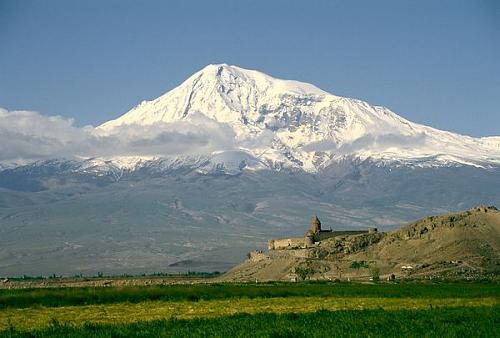
Near the top of Mount Ararat (seen from Armenia in a file photo) in Turkey, explorers claim to have found Noah's ark.
4. Noah's Ark Found in Turkey?
A team of evangelical Christian explorers claim they've found the remains of Noah's ark beneath snow and volcanic debris on Turkey's Mount Ararat (map).
But some archaeologists and historians are taking the latest claim that Noah's ark has been found about as seriously as they have past ones—which is to say not very.
"I don't know of any expedition that ever went looking for the ark and didn't find it," said Paul Zimansky, an archaeologist specializing in the Middle East at Stony Brook University in New York State.
Turkish and Chinese explorers from a group called Noah's Ark Ministries International made the latest discovery claim Monday in Hong Kong, where the group is based.
"It's not 100 percent that it is Noah's ark, but we think it is 99.9 percent that this is it," Yeung Wing-cheung, a filmmaker accompanying the explorers, told The Daily Mail.
3. Odd Species Found Off Greenland
Looking like a creature from the Alien movies, this nightmarish "longhead dreamer" anglerfish (Chaenophryne longiceps) was until recently an alien species to Greenland waters (map).
The dreamer, which grows to a not-so-monstrous 6.7 inches (17 centimeters) in length, is 1 of 38 fish species found around the Arctic island for the first time, according to a recent study led by biologist Peter Møller of the Natural History Museum of Denmark in Copenhagen.
Ten of the species new to Greenland are new to science too. All 38 were discovered since the last such survey in 1992.
Rising ocean temperatures due to global warming—which could be drawing unfamiliar fishes to the region—and increased deep-sea fishing may be responsible for the spike in fresh fish faces seen off Greenland, according to the study, published in February in the journal Zootaxa.
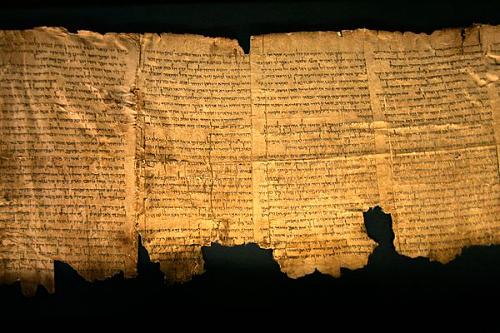
Sections of the Dead Sea Scrolls on display at the Israel Museum in Jerusalem in 2008.
2. Dead Sea Scrolls Mystery Solved?
The recent decoding of a cryptic cup, the excavation of ancient Jerusalemtunnels, and other archaeological detective work may help solve one of the great biblical mysteries: Who wrote the Dead Sea Scrolls?
The new clues hint that the scrolls, which include some of the oldest known biblical documents, may have been the textual treasures of several groups, hidden away during wartime—and may even be "the great treasure from the Jerusalem Temple," which held the Ark of the Covenant, according to the Bible.
The Dead Sea Scrolls were discovered more than 60 years ago in seaside caves near an ancient settlement called Qumran. The conventional wisdom is that a breakaway Jewish sect called the Essenes—thought to have occupied Qumran during the first centuries B.C. and A.D.—wrote all the parchment and papyrus scrolls.
But new research suggests many of the Dead Sea Scrolls originated elsewhere and were written by multiple Jewish groups, some fleeing the circa-A.D. 70 Roman siege that destroyed the legendary Temple in Jerusalem.
"Jews wrote the Scrolls, but it may not have been just one specific group. It could have been groups of different Jews," said Robert Cargill, an archaeologist who appears in the documentary Writing the Dead Sea Scrolls, which airs Tuesday at 9 p.m. ET/PT on the National Geographic Channel. (The National Geographic Channel is part-owned by the National Geographic Society, which owns National Geographic News.)
The new view is by no means the consensus, however, among Dead Sea Scrolls scholars.
"I have a feeling it's going to be very disputed," said Lawrence Schiffman, a professor of Hebrew and Judaic Studies at New York University (NYU).
Dead Sea Scrolls Written by Ritual Bathers?
In 1953, a French archaeologist and Catholic priest named Roland de Vaux led an international team to study the mostly Hebrew scrolls, which a Bedouin shepherd had discovered in 1947.
De Vaux concluded that the scrolls' authors had lived in Qumran, because the 11 scroll caves are close to the site.
Ancient Jewish historians had noted the presence of Essenes in the Dead Sea region, and de Vaux argued Qumran was one of their communities after his team uncovered numerous remains of pools that he believed to be Jewish ritual baths.
His theory appeared to be supported by the Dead Sea Scrolls themselves, some of which contained guidelines for communal living that matched ancient descriptions of Essene customs.
"The scrolls describe communal dining and ritual bathing instructions consistent with Qumran's archaeology," explained Cargill, of the University of California, Los Angeles (UCLA).
Dead Sea Scrolls: "Great Treasure From the Temple"?
Recent findings by Yuval Peleg, an archaeologist who has excavated Qumran for 16 years, are challenging long-held notions of who wrote the Dead Sea Scrolls.
Artifacts discovered by Peleg's team during their excavations suggest Qumran once served as an ancient pottery factory. The supposed baths may have actually been pools to capture and separate clay.
And on Jerusalem's Mount Zion, archaeologists recently discovered and deciphered a two-thousand-year-old cup with the phrase "Lord, I have returned" inscribed on its sides in a cryptic code similar to one used in some of the Dead Sea Scrolls.
To some experts, the code suggests that religious leaders from Jerusalem authored at least some of the scrolls.
"Priests may have used cryptic texts to encode certain texts from nonpriestly readers," Cargill told National Geographic News.
According to an emerging theory, the Essenes may have actually been Jerusalem Temple priests who went into self-imposed exile in the second century B.C., after kings unlawfully assumed the role of high priest.
This group of rebel priests may have escaped to Qumran to worship God in their own way. While there, they may have written some of the texts that would come to be known as the Dead Sea Scrolls.
The Essenes may not have abandoned all of their old ways at Qumran, however, and writing in code may have been one of the practices they preserved.
It's possible too that some of the scrolls weren't written at Qumran but were instead spirited away from the Temple for safekeeping, Cargill said.
"I think it dramatically changes our understanding of the Dead Sea Scrolls if we see them as documents produced by priests," he says in the new documentary.
"Gone is the Ark of the Covenant. We're never going to find Noah's Ark, the Holy Grail. These things, we're never going to see," he added. "But we just may very well have documents from the Temple in Jerusalem. It would be the great treasure from the Jerusalem Temple."
(Also see "King Herod's Tomb Unearthed Near Jerusalem, Expert Says.")
Dead Sea Scrolls From Far and Wide?
Many modern archaeologists such as Cargill believe the Essenes authored some, but not all, of the Dead Sea Scrolls.
Recent archeological evidence suggests disparate Jewish groups may have passed by Qumran around A.D. 70, during the Roman siege of Jerusalem, which destroyed the Temple and much of the rest of the city.
A team led by Israeli archaeologist Ronnie Reich recently discovered ancient sewers beneath Jerusalem. In those sewers they found artifacts—including pottery and coins—that they dated to the time of the siege. (Related:"Underground Tunnels Found in Israel Used In Ancient Jewish Revolt.")
The finds suggest that the sewers may have been used as escape routes by Jews, some of whom may have been smuggling out cherished religious scrolls, according to Writing the Dead Sea Scrolls.
Importantly, the sewers lead to the Valley of Kidron. From there it's only a short distance to the Dead Sea—and Qumran.
The jars in which the scrolls were found may provide additional evidence that the Dead Sea Scrolls are a collection of disparate sects' texts.
Jan Gunneweg of Hebrew University in Jerusalem performed chemical analysis on vessel fragments from the Qumran-area caves.
"We take a piece of ceramic, we grind it, we send it to a nuclear reactor, where it's bombarded with neutrons, then we can measure the chemical fingerprint of the clay of which the pottery was made," Gunneweg says in the documentary.
"Since there is no clay on Earth with the exact chemical composition—it is like DNA—you can point to a specific area and say this pottery was made here, that pottery was made over here."
Gunneweg's conclusion: Only half of the pottery that held the Dead Sea Scrolls is local to Qumran.
Scroll Theory "Rejected by Everyone"
Not everyone agrees with the idea that Dead Sea Scrolls may hail from beyond Qumran.
"I don't buy it," said NYU's Schiffman, who added that the idea of the scrolls being written by multiple Jewish groups from Jerusalem has been around since the 1950s.
"The Jerusalem theory has been rejected by virtually everyone in the field," he said.
"The notion that someone brought a bunch of scrolls together from some other location and deposited them in a cave is very, very unlikely," Schiffman added.
"The reason is that most of the [the scrolls] fit a coherent theme and hang together.
"If the scrolls were brought from some other place, presumably by some other groups of Jews, you would expect to find items that fit the ideologies of groups that are in disagreement with [the Essenes]. And it's not there," said Schiffman, who dismisses interpretations that link some Dead Sea Scroll writings to groups such as the Zealots.
UCLA's Cargill agrees with Schiffman that the Dead Sea Scrolls show "a tremendous amount of congruence of ideology, messianic expectation, interpretation of scripture, [Jewish law] interpretation, and calendrical dates.
"At the same time," Cargill said, "it is difficult to explain some of the ideological diversity present within some of the scrolls if one argues that all of the scrolls were composed by a single sectarian group at Qumran."
Caves Were for Temporary Scroll Storage?
If Cargill and others are correct, it would mean that what modern scholars call the Dead Sea Scrolls are not wholly the work of isolated scribes.
Instead they may be the unrecovered treasures of terrified Jews who did not—or could not—return to reclaim what they entrusted to the desert for safekeeping.
"Whoever wrote them, the scrolls were considered scripture by their owners, and much care was taken to ensure their survival," Cargill said.
"Essenes or not, the Dead Sea Scrolls give us a rare glimpse into the vast diversity of Judaism—or Judaisms—in the first century."
1. Fish With "Hands" Are New Species
Using its fins to walk, rather than swim, along the ocean floor in an undated picture, the pink handfish is one of nine newly named species described in a recent scientific review of the handfish family.
Only four specimens of the elusive four-inch (ten-centimeter) pink handfish have ever been found, and all of those were collected from areas around the city of Hobart (map), on the Australian island of Tasmania.
Though no one has spotted a living pink handfish since 1999, it's taken till now for scientists to formally identify it as a unique species.
The new-species determinations were made based on a number of factors, including number of vertebrae and fin rays, coloration, the presence of scales and spines, and proportional body measurements, according to review author Daniel Gledhill of Australia's Commonwealth Scientific and Industrial Research Organisation, or CSIRO.
All of the world's 14 known species of handfish are found only in shallow, coastal waters off southeastern Australia, the review notes.
Even among the previously known species, the fish are poorly studied, the review authors add, and little is known about their biology or behavior.
Did You Like Top Ten Discoveries of 2010: Nat Geo News's Most Popular?

 Invented a way to use an empty milk carton as a more environmentally-friendly doggy “poop scoop”.
 Walked 800 miles to a rainforest in order to save it.


 The heart is a four chambered pump. The top two chambers are called Atria, the bottom two are called Ventricles. They are separated from top to bottom by valves; the right and left sides are separated by a septum. So what makes the pump squeeze? Well the heart is a muscle, and like all muscles, when it gets shocked by electricity, it contracts. If you don’t believe me, just stick a fork in the nearest electrical socket and see if anything tenses up! (DISCLAIMER: Due to our lawyers incessant need to justify themselves, they advised us to say, “Don’t do that. It could cause you harm”). When the hearts muscle gets “shocked”, they contract and force the blood down its path. The valves I just spoke of are one way, and will not allow blood to flow back through the system. If it does, see your nearest physician cause death could be imminent!
 So let’s talk about this infamous “shocking” business. When the SA node becomes damaged, or simply isn’t working properly, other parts of the heart start to take over to create the heart beat. There are millions of foci in the heart that can make this beat happen. The reason why they normally don’t is that the SA node “overrides” them and they accept the impulse from it, instead of trying to create one on their own.
 Top Ten Discoveries of 2010: Nat Geo News's Most Popular